Powered by LimeSpot × Yotpo
Your store is sitting on a merchandising asset it hasn’t exploited yet. And no, it’s not locked in a dashboard or hiding in a spreadsheet nobody opens. It’s written in plain language, by customers who already bought from you, in the one place merchandising teams check for reassurance and rarely for direction: the reviews.
Take for example: A customer bought a serum for herself, loved it, and came back three weeks later to buy a second one for her mother. She said so, right there in the review box, in the same breath as the star rating: “got this for myself first, then had to order one for my mom.” Yet nobody read that sentence as anything other than a nice thing to say. So it sat under the product, doing its one job (reassuring the next shopper) and then it was forgotten, the same way most reviews get forgotten, one scroll down from where it landed. But that sentence was beyond praise for a great product from a happy customer. It was a gift-giving pattern you should be building a whole campaign around.
This plays out constantly. Review after review. Customers explain exactly why they bought, who they bought it for, what they paired it with, what almost stopped them. And almost none of it ever leaves the product page it was written on, because merchants file reviews under “testimonials” and stop there. But testimonials is the wrong word for what’s actually happening. Look closer and there’s a pattern: customers narrating their purchase decisions, in real time, for free. That’s a merchandising asset already paid for and going unused, and BFCM is the one weekend a year where the cost of leaving it unused is highest, because the traffic that would have converted on it only shows up once.
Why This Keeps Happening
Ecommerce stores are organized around a structure someone else built: categories, tags, collections, cross-sell rules from a meeting eighteen months ago that nobody’s revisited since. That structure reflects how your merchandising team thinks about the products. It doesn’t reflect how customers actually use them.
A skincare brand might file one serum under “hydration” and another under “anti-aging.” Clean, logical, defensible in a meeting. Then enough customers leave reviews saying they use both every morning, one right after the other, and it turns out the two products aren’t a hydration serum and an anti-aging serum to the person buying. They’re step one and step two of the same ritual. The tidy categories weren’t wrong. They were just missing the one relationship that mattered to the customer: what goes with what.
A pet supply brand might have an accessory sitting three pages deep in a collection, filed under extras because nobody thought much of it at launch. Meanwhile it keeps turning up, unprompted, in reviews of the brand’s bestseller, quietly becoming half of a pair the catalog never officially made. A catalog describes what a store is selling. It doesn’t know how people live with it. And during BFCM, every shopper who lands on the bestseller without ever seeing its unofficial pair is a bundle you didn’t sell, at the one moment buyers were most ready to buy it.
Meanwhile the reviews are sitting right there, being read for exactly one thing: reassurance. Is this product good? Are customers happy? Once that’s answered, the reviews are filed away. Nobody’s asking the harder question: what is this telling me to build?
What the Reviews Are Telling You
Read past the star rating to the sentence attached to it, and the instructions are surprisingly specific.
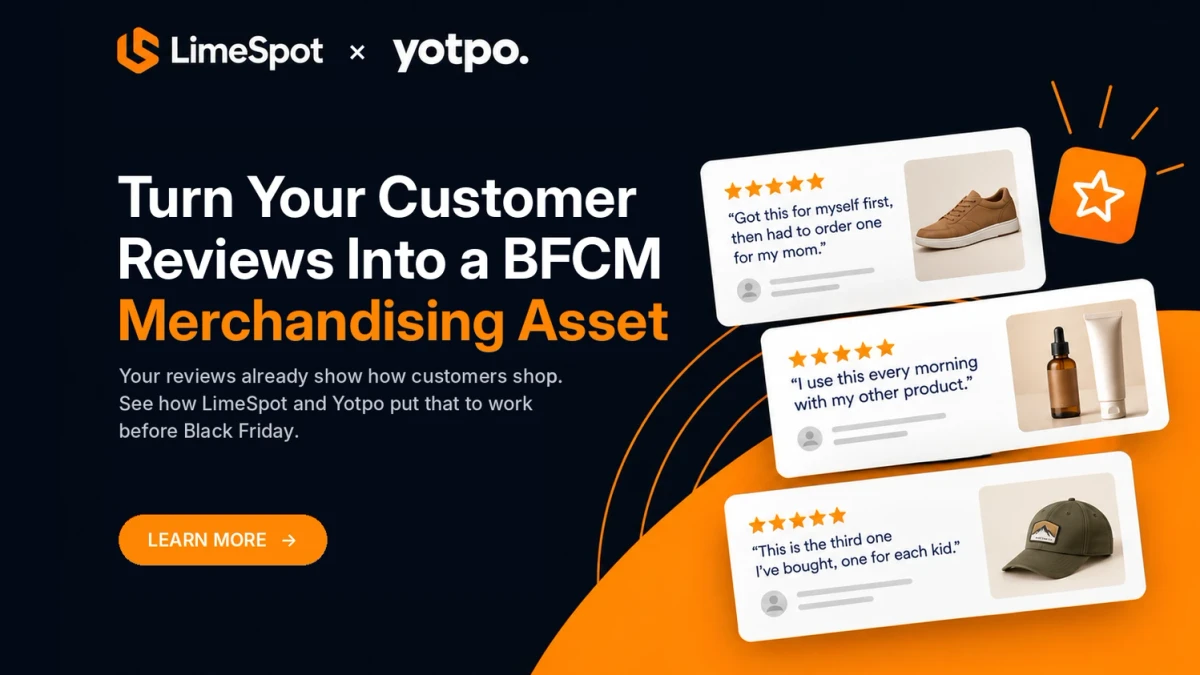
“I use this every morning with my other product” is a pairing the catalog missed. Two products that belong together in a customer’s real routine, whether or not your collection pages agree. Bundled and priced right, that’s a BFCM offer with a built-in reason to believe it.
“Got this for myself first, then had to order one for my mom” is a gift segment hiding inside a self-purchase. A shopper who looks like she’s buying for herself today, and will be buying for someone else in three weeks.
“This is the third one I’ve bought, one for each kid” is a replenishment cycle you didn’t know you had. Not a shopper to cross-sell once, but a shopper to remind, right around the time the second one starts running low.
“I wish I’d known this ran small before I ordered” is an objection that showed up a week too late. Surfaced earlier, it stops being damage control and starts preventing the return, which matters most during BFCM when rushed gift purchases drive return volume to its annual peak.
“This replaced the one I used to buy from [competitor]” is proof aimed at a specific kind of stranger: one still loyal to something else, on the one weekend she’s actively shopping around.
Here is the problem. A catalog of a few hundred products carries tens of thousands of sentences like these. The merchandiser who is supposed to read them is the same person building the discount schedule, the landing pages, and the email calendar. Reading reviews for merchandising signals isn’t a bad idea. It’s an idea that almost never gets done, and in the six weeks before BFCM, it doesn’t get done by anyone.
How It Works
This is where the LimeSpot × Yotpo pairing changes the job. Not by reading the reviews for you, but by making the reading unnecessary.
Every pattern in the reviews above is also a pattern in purchase behavior. The customer who wrote “I use this with my other serum” also bought both serums, in the same order or a few weeks apart. The customer who bought one for her mom placed a second order for the same product to a different address. The parent buying one per kid shows up as three purchases on a predictable cycle. The review is the human-readable version of the signal. The order history is the machine-readable version. And LimeSpot is already reading the second one, across every shopper, all the time.
That’s what LimeSpot’s recommendations are: the patterns in your reviews, detected from behavior, at a scale no merchandiser could read by hand.
- Bought Together is the “I use this with X” review, found from the thousands of carts where both items appeared, and shown on the product page before the shopper has to go looking.
- In-cart recommendations are the unofficial pair the catalog never made, surfaced at the moment of highest intent, because shoppers who bought what’s in the cart went on to buy it.
- Post-purchase and order-status recommendations are the “ordered another for my mom” review, acted on while the shopper is still in a buying frame of mind.
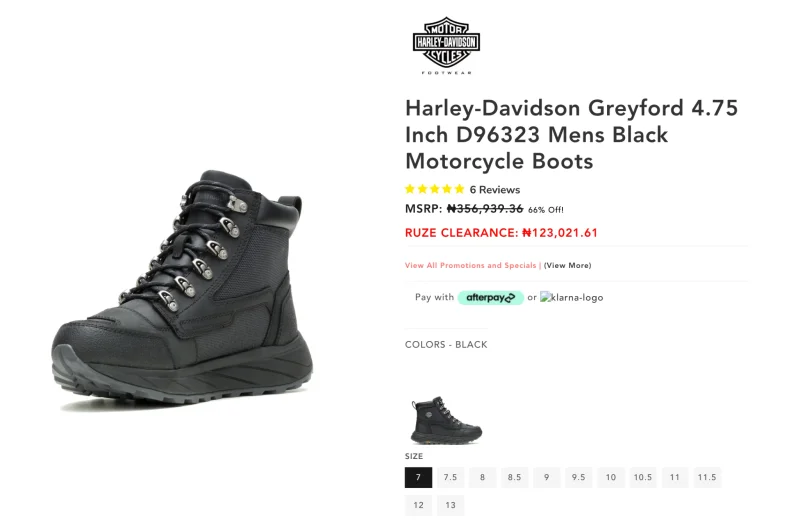
What Yotpo adds is the half that behavior can’t supply: the reason to believe. A recommendation tells the shopper what to consider. A review tells her why. Connect the two, and every LimeSpot recommendation renders with its Yotpo star rating attached, pulled live from your review data, with no one on your team touching it. The shopper sees the suggestion and the proof in the same glance, whether she’s on a product page, in the cart, or on the order confirmation page.
Put plainly: the reviews tell you what to build. LimeSpot builds it from the behavior behind those reviews, automatically. Yotpo makes the shopper believe it when she sees it. Nobody reads forty thousand reviews with a notebook open, and the pattern still makes it to the storefront.
What This Looks Like in Action
The two merchants below run LimeSpot and Yotpo together: Yotpo collecting the reviews, LimeSpot deciding what each shopper sees next, and the two connected so recommendations carry the proof with them. Their catalogs couldn’t be more different — sneakers and 4×4 gear — and so is how hard each store leans on recommendations. The pattern holds across both: shoppers shown personalized, review-backed recommendations convert at a meaningfully higher rate than shoppers who navigate the store on their own.
Ruze Shoes: The Pair She Kept Coming Back To
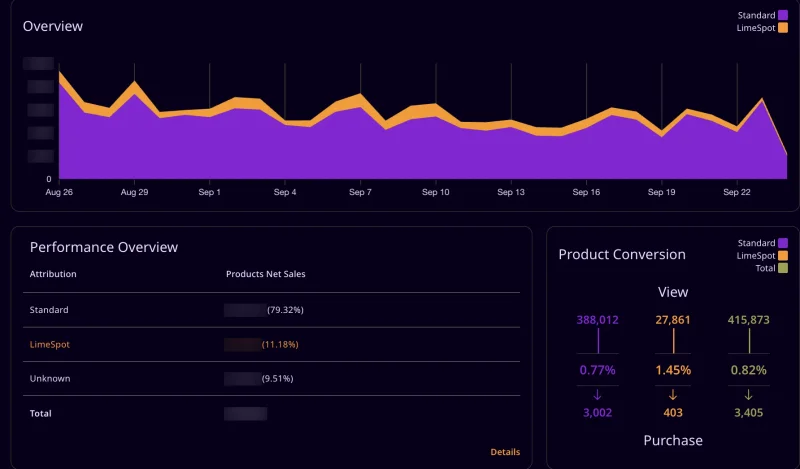
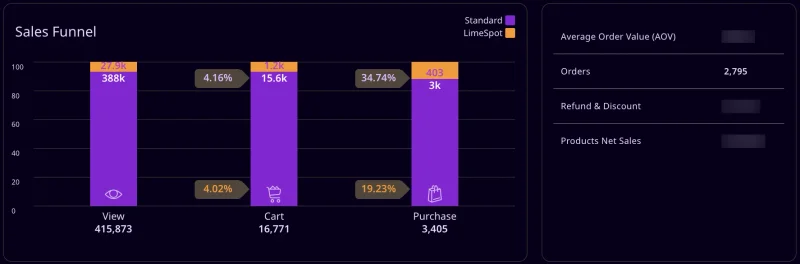
LimeSpot analytics, last 30 days (Aug 26 – Sep 24, 2026). Currency figures withheld at merchant’s discretion.
Ruze Shoes, the Southern California online footwear retailer, carries a deep multi-brand catalog of sneakers, boots, and dress shoes. Shoe shopping is a comparison sport: a shopper opens six tabs, narrows to two pairs, hesitates on size or color, and leaves. The sale usually belongs to whoever brings her back to the pair she was already circling.
That’s exactly where LimeSpot earns its keep at Ruze. Recently Viewed recommendations account for the overwhelming majority of recommendation revenue, putting the pair she considered back in front of her, rating attached, at every return visit. Over the past 30 days, products surfaced by a LimeSpot recommendation converted from view to purchase at 1.45%, against 0.77% for products found through standard navigation. Once a recommended pair was in the cart, it was purchased 35% of the time, versus 19% for the rest of the store. In total, recommendations drove just over 11% of net sales — the largest revenue share of any store in this piece.
ARB 4x4 Accessories: Gear That Belongs on the Same Build
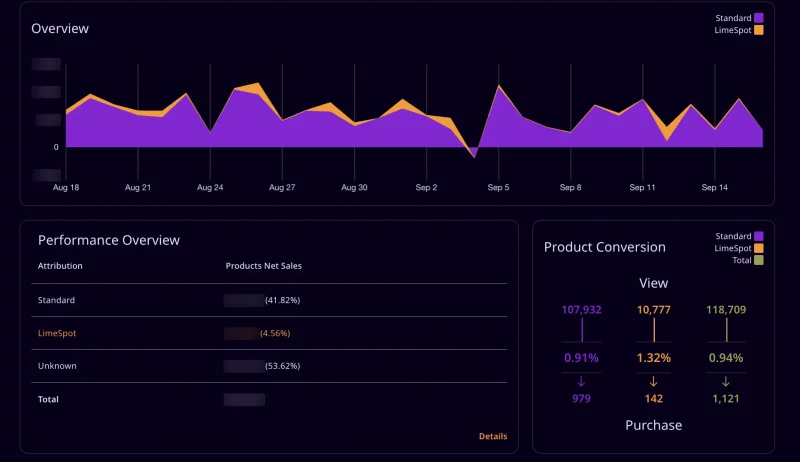
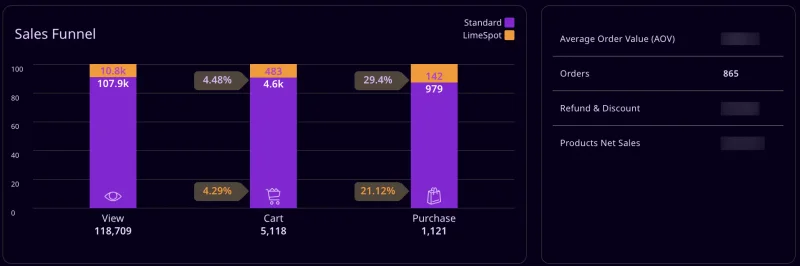
LimeSpot analytics, last 30 days (Aug 18 – Sep 16, 2026). Currency figures withheld at merchant’s discretion.
ARB sells 4×4 and overlanding equipment: bull bars, suspension, fridges, rooftop tents, and the hundreds of parts that turn a stock truck into a build. It’s a catalog where almost nothing is bought alone, because the customer isn’t buying a product, she’s assembling a setup — and the reviews read accordingly: what was installed with what, what fit which vehicle, what completed the kit. The “I use this with X” review isn’t an occasional find here. It’s the house style.
That shows up in the numbers as a store that lives on cross-sell. Of everything LimeSpot recommendations sold in the past 30 days, 95% came through cross-sell placements. Products surfaced by a recommendation converted from view to purchase at 1.32%, against 0.91% for standard navigation, and once a recommended part was in the cart, it was purchased 29% of the time versus 21% for the rest of the store. When the catalog is a set of unofficial pairs waiting to be completed, the recommendation box is where they get completed.
Two stores, two levels of effort, the same direction of result. What they have in common isn’t a merchandising team reading reviews. It’s that the patterns in the reviews are reaching the storefront anyway, with the proof attached.
What to Do Next (Before BFCM Hits)
Somewhere in your store, right now, is a review like the one about the serum. A pairing in the catalog is missing. A gift segment hiding inside a self-purchase. A repeat buyer you haven’t started treating like one. You don’t have to go find it. You have to make sure the tools that already see it are connected and placed where the traffic will be.
- Connect LimeSpot and Yotpo. Install LimeSpot, go to Extensions → Integrations and select Yotpo. Ratings are off by default on new installs, so switch them on under Personalization → Designer. From here on, every recommendation carries its rating.
- Put a box in the cart. If you take one placement from the stores above, take this one. It’s where the highest-intent shopper of the weekend is standing, and where the unofficial pair gets sold.
- Let LimeSpot Growth Grader find the gaps for you. If you’d rather not audit placements by hand, run LimeSpot’s free Growth Grader on your store. It reviews your live personalization setup: which placements are working, which are missing, which are underperforming, and can apply the fixes for you. The checklist above, run in minutes instead of an afternoon.
- Turn on Bought Together for your top 20 products. The ones most likely to carry your BFCM traffic. Let the pairings come from behavior rather than from a category rule written eighteen months ago.
- Add a recommendation box to the order status page. That’s the “one for my mom” moment. The shopper has just decided she trusts you; show her what buyers like her came back for.
- Read the attribution on Cyber Monday night. LimeSpot reports revenue per box and per page. You’ll see which placements paid for themselves and which to retire in December.
The reviews are already written. The behavior behind them is already being read. All that’s left is to let the two show up in the same place before the traffic that would have converted on them arrives.